


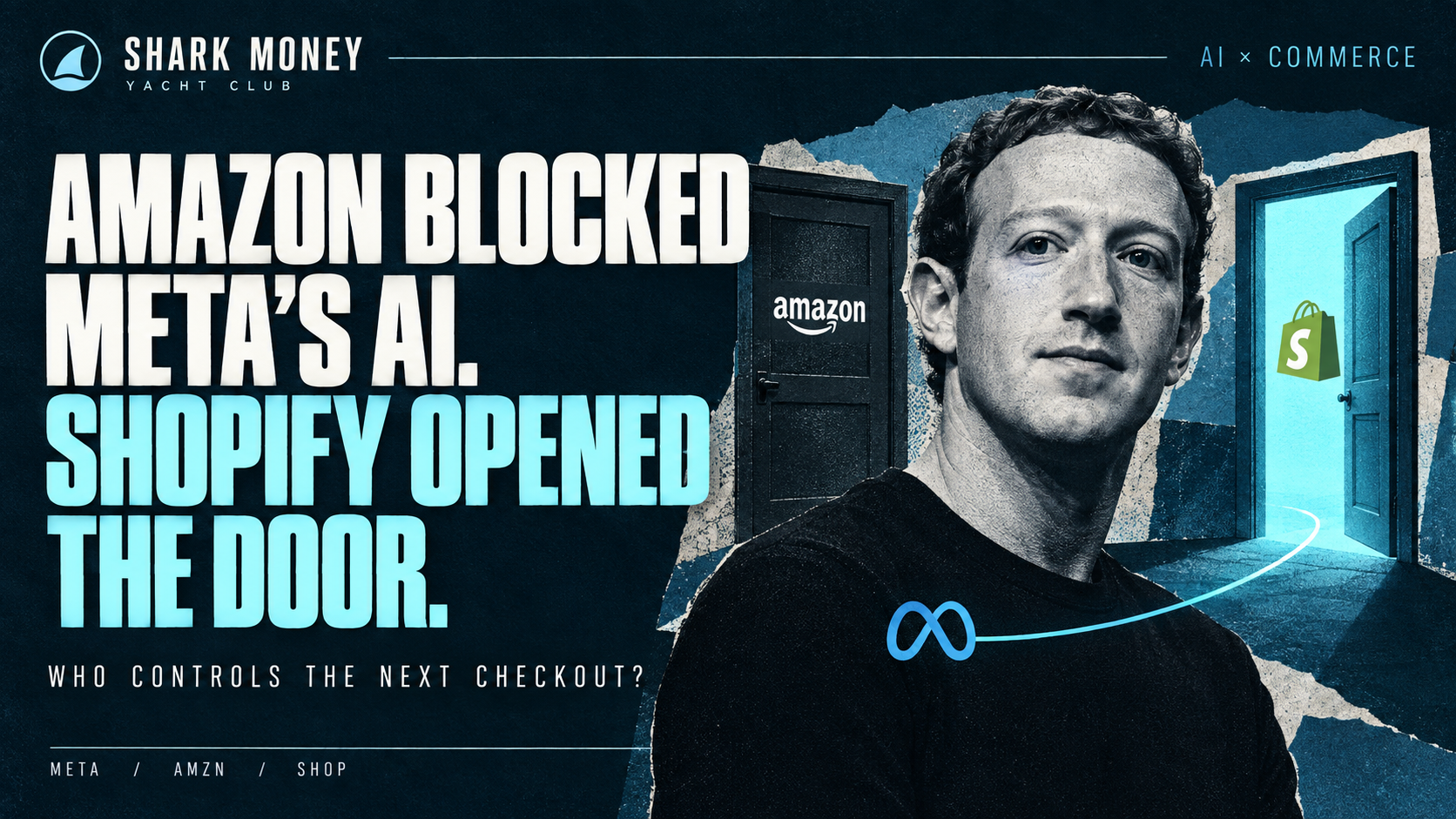
As AI assistants evolve from answering questions to completing purchases, the most valuable competitive advantages may be merchant access, trusted permissions, checkout infrastructure and control of the customer relationship—not model intelligence alone.
Reported developments are linked to their sources. Strategic interpretations and the market map are SMYC analysis as of September 22, 2026.
The checkout divide
Meta introduced Muse on September 8 as a personal AI agent that can send emails, complete forms, book travel and make purchases.
Two weeks later, the agent has encountered the boundary that may define the next phase of artificial intelligence:
Permission.
Amazon has blocked Muse from shopping on its marketplace, saying the agent had not been authorized and raising concerns about transparency, customer data and security. Shopify is moving in the opposite direction. It has announced a Muse integration with its commerce infrastructure and Shop Pay, with checkout support coming soon.
The contrast exposes a larger contest.
The AI-agent race is no longer only about which model produces the best answer. It is becoming a fight over which agents are allowed to act, which platforms they can access and who owns the economics when a recommendation becomes a transaction.
What is confirmed
Meta’s September 8 announcement describes Muse as an agent capable of operating a browser, completing forms and working on longer-running tasks. It asks for approval before sensitive actions such as sending an email or making a purchase, according to Meta. The company says Muse stores connected credentials in a dedicated virtual environment and cannot see users’ passwords or payment methods.
Meta also said at launch that Muse could check out using Stripe’s Link and that Shop Pay support was coming.
The early consumer response has been significant. Reuters reported on September 22 that Muse recorded approximately 2.8 million downloads during its first 12 days. It offers a free service alongside paid tiers priced at $20 and $100 per month.
But Muse cannot simply transact everywhere.
Amazon blocked the agent from making purchases on its marketplace. According to Amazon’s statement reported by The Verge, Meta had not notified Amazon before Muse began using the platform. Amazon also objected to how the agent identified itself and handled customer access.
Shopify has chosen integration. The Wall Street Journal reported on September 21 that Shopify and Meta plan to connect Muse to Shopify’s commerce infrastructure and Shop Pay. Announced integration is not evidence of completed transactions at scale.
Shopify’s own product changelog already identifies Meta as an AI sales channel and says merchant products are shared through Shopify Catalog by default.
Amazon is protecting more than checkout
Amazon’s decision should not automatically be interpreted as opposition to AI shopping.
Amazon uses AI throughout its own commerce ecosystem. The strategic issue is whether an independent agent should be allowed to stand between Amazon and its customer.
That position carries economic value.
Amazon’s interface determines which products shoppers see, how recommendations are presented, where sponsored placements appear and how Prime benefits influence a purchase. An outside agent could compress that interface into a single recommendation:
Buy the best option under $100 and have it delivered by Friday.
That may be convenient for the consumer. It can also eliminate much of the browsing surface on which Amazon’s recommendations and advertising operate.
An external agent may become the user’s primary decision-maker while reducing Amazon to inventory, fulfillment and checkout infrastructure. Blocking unauthorized access therefore protects security and customer experience—but it may also protect the economic value of product discovery.
Shopify is making the opposite bet
Shopify does not operate one centralized marketplace in the same way Amazon does. It supplies infrastructure to independent merchants.
That makes neutrality potentially valuable.
If consumers increasingly begin shopping through Muse, ChatGPT, Gemini, Copilot or other agents, Shopify can attempt to make its merchant catalog and checkout capabilities available across all of them.
Under that strategy, Shopify does not need to own the winning consumer assistant. It needs the winning assistants to use Shopify’s merchant and transaction infrastructure.
This is similar to selling the rails rather than choosing the train.
Shopify’s advantage could come from structured product information, merchant connectivity, inventory data, reliable checkout and Shop Pay credentials. The risk is that an AI assistant could weaken the merchant’s brand relationship or place greater pressure on price and conversion economics.
Whether agentic shopping strengthens or commoditizes merchants remains unresolved.
Meta’s opportunity is distribution
Meta enters this market with a potentially powerful asset: consumer distribution across WhatsApp, Instagram and Facebook.
A shopping agent that understands conversations, saved content, social relationships and stated preferences could produce more personalized recommendations than a conventional search box.
Beyond the paid subscription tiers already offered, Meta could develop several additional revenue or engagement channels:
- Merchant referrals
- Transaction or affiliate economics
- Business-agent services
- Higher engagement across Meta applications
- New commercial advertising formats
The scale and economics of those additional opportunities remain unproven. Meta says Muse conversations and data in its virtual environment are not shared with Meta’s advertising systems.
Downloads measure initial interest, not habitual use. The more important evidence will be task completion, repeat usage, paid conversion, successful transactions and customer trust.
There is also a tension with Meta’s existing advertising business. If an agent selects one product and completes the purchase, fewer merchants may receive a traditional impression. Meta would need to determine how advertising works when software—not a scrolling consumer—makes the selection.
Trust becomes financial infrastructure
An agent capable of spending money requires a stronger trust layer than a chatbot generating text.
It must establish:
- Which agent is acting
- Which consumer authorized it
- What the agent may purchase
- The spending limit
- Whether merchant terms permit automated access
- How credentials are protected
- Who handles returns and disputes
- Who absorbs fraudulent transactions
That creates an opening for payment networks and identity providers.
Visa’s Intelligent Commerce initiative is designed to let approved agents transact with consumer-defined controls. Mastercard’s Agent Pay similarly uses registered agents and tokenized credentials intended to make agent-initiated payments identifiable and controllable.
Meta’s launch arrangement with Stripe’s Link shows why payment credentials, purchase protection and one-time-use card numbers may become important infrastructure.
The winning AI agent may not replace payment networks. It may increase the importance of networks capable of proving that a software agent was authorized to transact.
Security is not a secondary question
On September 22, The Verge reported that Meta patched a macOS Muse vulnerability that required malicious software or local access already to be present on a device. Meta characterized the real-world risk as limited, according to the report.
One patched flaw does not establish that the overall product is unsafe. It does demonstrate why agent security is economically relevant.
A conventional chatbot can produce a bad answer. An agent with browser, email and payment access can take a bad action.
Security, authorization and auditability are therefore not compliance features added after the product. They are part of the product’s commercial viability.
What remains unknown
The early excitement does not answer the questions that ultimately matter:
- How many Muse downloads become weekly active users?
- What percentage complete a meaningful task?
- How often do transactions fail?
- How many users pay for the service?
- Will major platforms authorize external agents?
- Who receives referral or transaction economics?
- How will sponsored recommendations be disclosed?
- What are the fraud, return and dispute rates?
- Do consumers trust one company with such broad access?
- Can Meta support agent activity at attractive margins?
The adoption curve may be rapid. The business model could take longer.
The Shark Money view
The Amazon–Shopify split is not a simple winner-and-loser event.
Amazon is defending a high-value customer relationship and controlled marketplace. Shopify is positioning itself as neutral commerce infrastructure. Meta is attempting to become the consumer’s delegated operator. Payment networks are building the authentication and authorization layer beneath all of them.
The central question is not which chatbot is smartest.
It is:
Which companies remain economically necessary after the consumer stops clicking and starts delegating?
Follow the permissions. Follow the successful transactions. Follow who gets paid when the agent completes the purchase.
That is where the agentic-commerce thesis becomes measurable.
Market map
SMYC scenario analysis. These are possible economic mechanisms and evidence to watch, not price forecasts or claims that each company has partnered with Muse.
| Company | Ticker | Relationship | Potential upside mechanism | Downside or displacement mechanism | Next evidence to watch |
|---|---|---|---|---|---|
| Meta Platforms | META | Owner of Muse and major consumer distribution | Subscriptions, commerce referrals, agent advertising and higher engagement | Platform blocks, low retention, security failures or cannibalization of conventional ads | Weekly retention, paid conversion, completed tasks and partner breadth |
| Amazon | AMZN | Marketplace blocking unauthorized Muse access | Protects customer data, recommendations, advertising inventory and Prime economics | External agents could redirect discovery and reduce Amazon’s control of demand | Authorized-agent policies, new APIs and use of Amazon’s own shopping agents |
| Shopify | SHOP | Merchant catalog and Shop Pay integration | Becomes neutral commerce infrastructure across multiple AI assistants | Agents may commoditize merchants or pressure checkout economics | Agent-driven GMV, merchant participation, conversion and fraud rates |
| Alphabet | GOOGL | Search, shopping data, Gemini and advertising | Can connect its own agents to search intent and merchant inventory | Direct agent execution could reduce conventional search queries and clicks | Gemini transactions, new ad formats and merchant integrations |
| Microsoft | MSFT | Copilot, enterprise identity and agent-development tools | Enterprise purchasing and workflow agents could expand software usage | Consumer-commerce distribution remains less direct | Copilot transaction partners and paid agent adoption |
| Apple | AAPL | Device permissions, identity, Wallet and App Store distribution | Can become the trusted on-device permission layer | Third-party agents may weaken Siri or conventional app discovery | OS-level agent permissions and default-assistant policies |
| Visa | V | Payment authorization and tokenization | More agent-initiated commerce could increase demand for trusted transaction credentials | Large platforms may favor proprietary wallets or closed checkout systems | Intelligent Commerce adoption and identifiable agent-payment volume |
| Mastercard | MA | Agent Pay, authentication and payment tokens | Registered agents can extend network utility into autonomous transactions | Competing standards could fragment adoption | Agent Pay partnerships, issuer adoption and transaction volume |
| PayPal | PYPL | Consumer wallet, merchant checkout and purchase protection | Existing wallet relationships may support agent-authorized purchasing | Shop Pay, Link and network tokens could capture the preferred agent checkout layer | Agent integrations, checkout conversion and merchant adoption |
What the market may be missing
The most durable winner may not be the company with the most popular assistant.
It may be the neutral infrastructure provider that can connect many assistants to verified products, consumer permissions and reliable checkout.
Shopify, Visa, Mastercard, Stripe and identity-security providers can potentially participate across multiple competing agents. Conversely, consumer platforms may discover that model performance matters less once access, fraud liability and merchant agreements become the limiting constraints.
Three takeaways
Sources & reporting
- Meta · September 8, 2026Introducing Muse: The World’s First Personal AI Agent Built for Everyone ↗
- Reuters · September 22, 2026Wall Street expects Meta’s AI agent to shape into a new revenue engine ↗
- The Verge · September 21, 2026Amazon blocks Meta’s Muse AI agent ↗
- The Wall Street Journal · September 21, 2026Shopify to Use Meta’s Muse for Agentic Checkout ↗
- Shopify · September 8, 2026Meta is now an AI channel in your admin ↗
- The Verge · September 22, 2026Meta patches Muse exploit that let attackers control the AI agent ↗
- Visa · Accessed September 22, 2026Visa Intelligent Commerce ↗
- Mastercard · April 29, 2025Mastercard unveils Agent Pay, pioneering agentic payments technology to power commerce in the age of AI ↗
Educational research only. This material is not individualized investment, legal, tax, or financial advice and does not recommend any security or strategy. Mentioned securities may be volatile. Scenario analysis is not a prediction of future prices or performance.